05/20/13

The imaginary worlds of the Brontës

Thanks to my mother, for a long time I’ve known that the Brontës — Charlotte, Emily, Anne and Branwell — collaborated on writing together as children. They wrote in tiny writing in tiny notebooks. What I didn’t know was that they wrote about an imaginary shared realm, the world of the Glass Town Federation. They initially invented the kingdom of Angria, after which the two younger siblings, Emily and Anne, discontent with being forced into lesser realms, created their own land of Gondal. (If you’re hearing echoes of Angmar and Gondor, you’re not the only one — but I haven’t been able to find the slightest hint of a connection).

The enterprise began with a set of toy soldiers that Branwell received. Charlotte chose the Duke of Wellington, Branwell chose Napoleon (which, as blogger Transient points out, was like “playing Superman and Lex Luthor”, and Emily and Anne chose the Arctic explorers Parry and Ross). Each character had his own kingdom, with the capital of each one called Glass Town.

From the British Library:

They became obsessive about their imaginary worlds, drawing maps and creating lives for their characters and featured themselves as the ‘gods’ (‘genii’) of their world. Their stories are in tiny micro-script, as if written by their miniature toy soldiers.

The Brontës wrote about their imaginary countries in the form of long sagas which were ‘published’ as hand-written books and magazines, reminiscent of the early fanzines created by science fiction fans from the 1930s, as well as the imaginary worlds made up by many writers such as JRR Tolkien and CS Lewis in their childhood and adolescence. Just like today’s writers of ‘fan-fiction’ who use characters and settings from their favourite television shows and books (from Star Trek to Harry Potter), the Brontës used both fictional and real-life characters, such as the Duke of Wellington.


05/20/13

Slip-cast porcelain

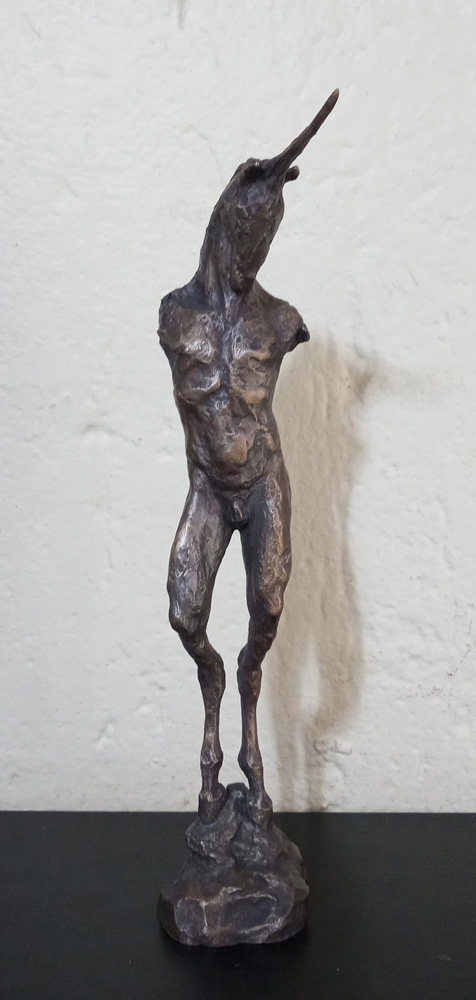
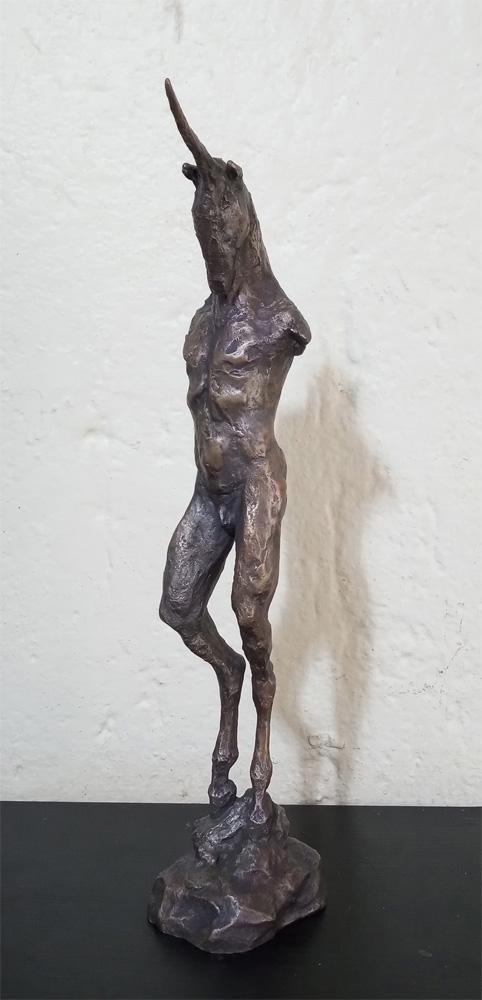
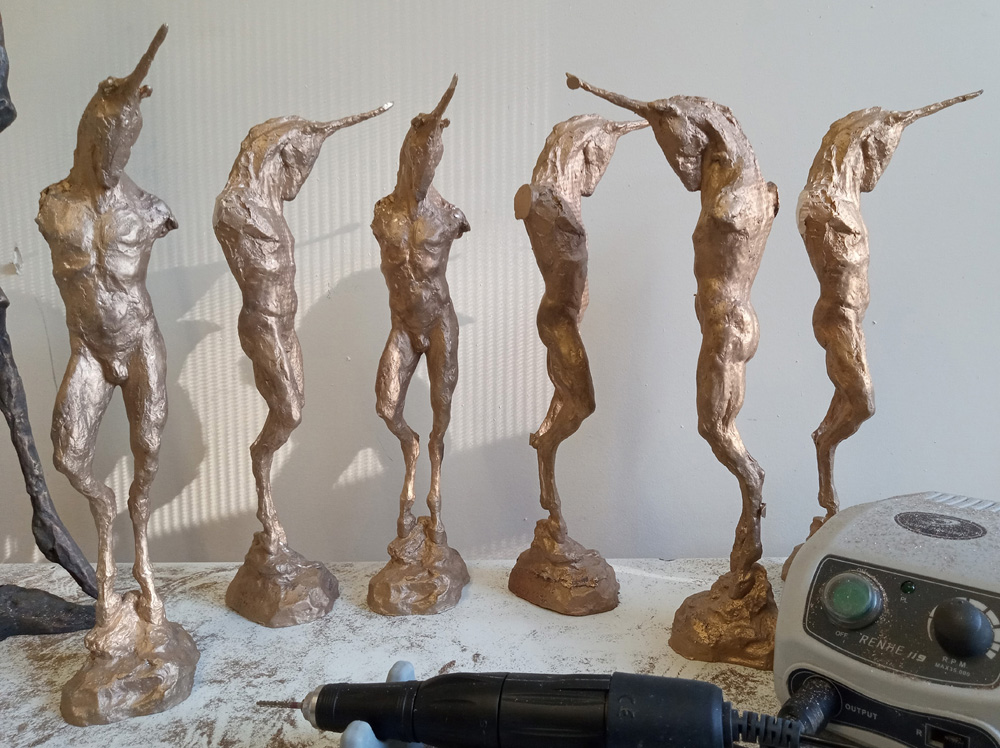
I’ve been looking into slip-cast porcelain as an alternative to bronze. It looks rather promising — something you can do at home, then take to a kiln to be fired. I don’t know where I could buy supplies in Bangkok — I’m sure there’s somewhere, I just don’t know where, or how easy it is to get to — so I might buy some here and take them back. I’ve got a couple of pieces to try making that I don’t think will be terribly difficult — fingers crossed!

05/20/13

Aurealis Award for Mad Ancestor

The Aurealis Awards have been announced, and I’m honoured and delighted that That Book Your Mad Ancestor Wrote received the award for best collection. Many thanks to the judges and organisers of the awards for all their work, and congratulations to all the winners and finalists! I owe a lot to the beta readers whose comments and critique helped me so much to work up the stories for the book: Nick Tramdack, Kirby Crow, Gillian Polack, Laurie Bland and Andrew van der Stock. Huge appreciation, guys! My thanks also to Kyla Ward for kindly accepting the award on my behalf.

2012 Aurealis Awards (winners in bold):

CHILDREN’S FICTION (told primarily through words)
Brotherband: The Hunters by John Flanagan (Random House Australia)

Princess Betony and the Unicorn by Pamela Freeman (Walker Books)
The Silver Door by Emily Rodda (Scholastic)
Irina the Wolf Queen by Leah Swann (Xoum Publishing)

CHILDREN’S FICTION (told primarily through pictures)
Little Elephants by Graeme Base (author and illustrator) (Viking Penguin)

The Boy Who Grew Into a Tree by Gary Crew (author) and Ross Watkins (illustrator) (Penguin Group Australia)
In the Beech Forest by Gary Crew (author) and Den Scheer (illustrator) (Ford Street Publishing)
Inside the World of Tom Roberts by Mark Wilson (author and illustrator) (Lothian Children’s Books)

YOUNG ADULT NOVEL
Dead, Actually by Kaz Delaney (Allen & Unwin) – Joint winner

And All The Stars by Andrea K. Host (self-published)
The Interrogation of Ashala Wolf by Amberlin Kwaymullina (Walker Books)
Sea Hearts by Margo Lanagan (Allen & Unwin) – Joint winner
Into That Forest by Louis Nowra (Allen & Unwin)

YOUNG ADULT SHORT STORY
“Stilled Lifes x11” by Justin D’Ath (Trust Me Too, Ford Street Publishing)
“The Wisdom of the Ants” by Thoraiya Dyer (Clarkesworld)
“Rats” by Jack Heath (Trust Me Too, Ford Street Publishing)
“The Statues of Melbourne” by Jack Nicholls (Andromeda Spaceways Inflight Magazine 56)
“The Worry Man” by Adrienne Tam (self-published)

ILLUSTRATED BOOK / GRAPHIC NOVEL
Blue by Pat Grant (author and illustrator) (Top Shelf Comix)

It Shines and Shakes and Laughs by Tim Molloy (author and illustrator) (Milk Shadow Books)
Changing Ways #2 by Justin Randall (author and illustrator) (Gestalt Publishing)

COLLECTION
That Book Your Mad Ancestor Wrote by K.J. Bishop (self‐published)

Metro Winds by Isobelle Carmody (Allen & Unwin)
Midnight and Moonshine by Lisa L. Hannett & Angela Slatter (Ticonderoga Publications)
Living With the Dead by Martin Livings (Dark Prints Press)
Through Splintered Walls by Kaaron Warren (Twelfth Planet Press)

ANTHOLOGY
The Year’s Best Australian Fantasy and Horror 2011 edited by Liz Grzyb and Talie Helene (Ticonderoga Publications)
Bloodstones edited by Amanda Pillar (Ticonderoga Publications)
The Best Science Fiction & Fantasy of the Year Volume 6 edited by Jonathan Strahan (NightShade Books)
Under My Hat edited by Jonathan Strahan (Random House)
Edge of Infinity edited by Jonathan Strahan (Solaris Books)

HORROR SHORT STORY
“Sanaa’s Army” by Joanne Anderton (Bloodstones, Ticonderoga Publications)
“Elyora” by Jodi Cleghorn (Rabbit Hole Special Issue, Review of Australian Fiction)
“To Wish Upon a Clockwork Heart” by Felicity Dowker (Bread and Circuses, Ticonderoga Publications)
“Escenade un Asesinato” by Robert Hood (Exotic Gothic 4, PS Publishing)
“Sky” by Kaaron Warren (Through Splintered Walls, Twelfth Planet Press)

HORROR NOVEL
Bloody Waters by Jason Franks (Possible Press)
Perfections by Kirstyn McDermott (Xoum)
Blood and Dust by Jason Nahrung (Xoum)
Salvage by Jason Nahrung (Twelfth Planet Press)

FANTASY SHORT STORY
“Sanaa’s Army” by Joanne Anderton (Bloodstones, Ticonderoga Publications)
“The Stone Witch” by Isobelle Carmody (Under My Hat, RandomHouse)
“First They Came” by Deborah Kalin (Andromeda Spaceways Inflight Magazine 55)
“Bajazzle” by Margo Lanagan (Cracklescape, Twelfth Planet Press)
“The Isles of the Sun” by Margo Lanagan (Cracklescape, Twelfth Planet Press)

FANTASY NOVEL
Bitter Greens by Kate Forsyth (Random House Australia)
Stormdancer by Jay Kristoff (Tor UK)
Sea Hearts by Margo Lanagan (Allen & Unwin)
Flame of Sevenwaters by Juliet Marillier (PanMacmillan Australia)
Winter Be My Shield by Jo Spurrier (HarperVoyager)

SCIENCE FICTION SHORT STORY
“Visitors” by James Bradley (Review of Australian Fiction)
“Significant Dust” by Margo Lanagan (Cracklescape, Twelfth Planet Press)
“Beyond Winter’s Shadow” by Greg Mellor (Wild Chrome, Ticonderoga Publications)
“The Trouble with Memes” by Greg Mellor (WildChrome, Ticonderoga Publications)
“The Lighthouse Keepers’ Club” by Kaaron Warren (Exotic Gothic 4, PS Publishing)

SCIENCE FICTION NOVEL
Suited by Jo Anderton (Angry Robot)
The Last City by Nina D’Aleo (Momentum)
And All The Stars by Andrea K Host (self-published)
The Interrogation of Ashala Wolf by Ambelin Kwaymullina (Walker Books)
Confusion of Princes by Garth Nix (Allen & Unwin)
The Rook by Daniel O’Malley (HarperCollins)

PETER MCNAMARA CONVENORS’ AWARD FOR EXCELLENCE
Kate Eltham

KRIS HEMBURY ENCOURAGEMENT AWARD
Laura Goodin

05/16/13

Historical tidbit

So Casanova’s talking about going to Fontainebleau palace, seeing Louis XV go to chapel with the royal family and ladies of the court, and then wandering through the apartments. Just, you know, having a sticky. He watches Marie Antoinette (ETA: oops, wrong queen. The Marie before her) having her dinner.

This surprised me — I assumed that in a place like that there’d be security everywhere, and that you’d only be able to hang out in the main reception rooms — but evidently not.

05/8/13

More Casanova

I’ve downloaded the entire memoirs of Casanova from Gutenberg. No clickable index, but hey, they’re free. What can I say, he’s fun to hang out with. He’s no delicate Pierrot out of Watteau, either. He’s beaten up a couple of guys and been in a couple of duels so far. I wasn’t aware until now that he also wrote an early science fiction novel, his Icosameron (see here: Colour-Coded Hermaphroditic Dwarves from within the Hollow Earth) of which, sad to say, Ed Wood didn’t make a film. Although Fellini did make a film about Casanova, with Donald Sutherland in the lead role. The Guardian says: “The semi-coherent, death-obsessed narrative reeks of self-disgust and has the clammy atmosphere of an undertaker’s embalming room.” Take me there, baby! Here’s a scene with a mechanical doll:

http://www.youtube.com/watch?v=EotNv1Tsa_Q

(Publisher’s Weekly describes the Icosameron thus: “Very much an example of Age-of-Enlightenment utopian literature, it tells of the wondrous revelations of Edward and his sister-wife Elizabeth, who return to their native England in 1615 after an absence of 81 years dwelling among the Megamicres of Protocosmos in the interior of the planet. In a land where love is all and flood, famine, war and slavery unknown, the couple spawns 40 pairs of twins who, in turn, people their universe. Flying horses, mechanical music, quasi-electrical telegraphy, a language, a religion and a philosophy are components of this tale in which Casanova displays wide learning and vivid imagination as well as a modicum of narrative skills.”)

I’m finding his amorous adventures less interesting than his cons and swindles; he gets up to some wonderfully daft hijinks, such as masquerading as a magician to raise some treasure from underground (maybe that was where he got his hollow earth idea). He knew it wasn’t going to work; he just wanted to play at being a magician. One could spend a lifetime trying to tease the man in the memoirs apart from the man who wrote them. The character in the memoirs is not at all stable; he’s emotional, highly impulsive, and given to deceit as much as he’s apparently given to honesty (writing casually about sundry misbehaviour and his bouts with VD). I’m reading them as historical fiction, based on fact, but written by a great liar and show-off.

04/29/13

Casanova

I’ve finished reading vol.1 of Casanova’s memoirs, written when he was old, washed up and working as a librarian. Truth, exaggeration or poppycock — who knows, who cares? Casanova charms, screws and scams his way through the world — and what a fascinating world it is. The picture of 18th century Europe (mainly Italy so far, with an excursion to Constantinople via Corfu) builds through his anecdotes, though I’ve found myself in need of reading some history to answer questions and fill in background. I definitely want to read the rest of his life story, though it’s time to pause for a few other books first. N.B. Don’t read Casanova expecting smoking hot erotica — he writes delicately about his sexual exploits.

04/24/13

Writing and anxiety

Writing isn’t one of my worst focuses of anxiety. I get worry and sinking feelings, and what I think of as lower level anxiety — the kind that can certainly interfere with work, without involving intense fear.

Still, worry and sinking feelings and lesser anxiety are still problems. I’ve been thinking about why — in my case, as I can’t speak for anyone else — writing causes these psychological effects. In no particular order, this is what I’ve come up with so far:

1. Tension between the pure/spontaneous/natural/naive — call it what you want — creative impulse and my expectations of readers’ expectations.

2. Financial insecurity. Few writers make a living from their work.  Writing well is not a guarantee. Writing badly is not a guarantee. Writing safely is not a guarantee. Writing boldly is not a guarantee. Not only the financial but the psychological aspects of this insecurity, especially in terms of self-judgement for “success” or “failure”, can be challenging.

3. Writing, for me, started off as a self-comforting activity — an escape from reality and from my own mental state. When it became a public, commercial matter, it ran into consensus reality and other people’s individual realities. Which was funny in a way, colliding or intersecting realities being a topic of interest to me, and one that I had used in my fiction. Psychologically, I still need writing to fulfil that self-comforting function. The stories I write certainly don’t have to be comfortable (in fact, I guess they tend not to be), but if I am torn by worries about what an A to Z of readers, all with their own tastes, needs and aversions, might want from me, the comfort (of privacy?) is lost and replaced with bad nerves. I try to wear a mental condom when I write, but it has a tendency to slip off. That might be why I’ve managed to write short stories and not another novel yet — I can keep the prophylactic on for a few thousand words.

It isn’t that I want to write with no thought of the reader, but the reader either needs to be someone like me or another single person, not a plural entity with wildly divergent personalities. As Kurt Vonnegut said: “Write to please just one person. If you open a window and make love to the world, so to speak, your story will get pneumonia.” I find that window can blow open rather too easily.

5. Writing can feel the opposite of self-focused. I’m not thinking about me, I’m listening to a head voice or thinking about the story. But that isn’t the same as thinking about another person. When push comes to shove, this is my stuff and I want and need to do it. There’s probably more self-focus in it than I consciously feel, and no doubt that can lead to anxiety.

6. Writing offers myriad opportunities to be unkind to myself. I can be constantly unkind, constantly unsatisfied, constantly demanding. If I think I’m “not good enough”, that attitude can seep through into my writing, making objective assessment difficult if not impossible — leading to uncertainty and loss of confidence.


04/12/13

The bird and the broom

Back when we were still living in Australia a bird flew into the flat through the ceiling fan in the kitchen. It got into the living room, where there was a window with a view of trees. On the wall opposite the window was a large mirror that reflected the view. The bird flew first to the window, smacked against the glass, turned around, flew at the mirror, smacked against the glass, and kept flying back and forth thus, smacking its beak on the glass each time.

The windows had fly screens, so that even if I opened the window the bird wouldn’t have been able to escape. All I could do was try to herd it, with a broom, out into the stairwell, which was the only exit from the flat. This took some doing, but eventually I shooed the bird out the door, and it flew down the stairwell and through the (open) door at the bottom.

I always thought there was probably an allegorical lesson in the incident. The bird had no way of knowing that the way out was through the stairwell. The stairwell didn’t look like the way out. The window and the mirror did. Nor did the bird (presumably) have any idea of my benign intention. I’m sure it didn’t have an aha! moment as I was chasing it with the broom. I just frightened it out of the room.

If I were the bird, I’ve always wondered what part of the psyche, which inner voice, would match up to the figure with the broom.